
Company Formation in Mexico
LATAM's 2nd largest economy · 8–12 weeks · RFC · No local director required
Formation Process
Incorporating a company in Mexico involves notarization by a Mexican Notario Público, registration with the Public Registry of Commerce, and RFC registration with SAT. The process is foreigner-friendly: no local director or Mexican shareholder is required. In practice, opening the corporate bank account is typically the slowest step, often taking longer than the notarial and registry filings combined, so foreign investors should budget for that timeline separately.
See the full company formation guideFormation Steps
- 1
Notarization of the incorporation deed by a Mexican Notario Público
- 2
Registration with the Public Registry of Commerce
- 3
RFC tax registration with SAT
- 4
Opening a corporate bank account in Mexico
- 5
IMSS registration (Mexican Social Security Institute) if hiring employees
Foreign Ownership
Mexico permits 100% foreign ownership in most business sectors. Certain industries, including energy, aviation, broadcasting, and financial services, have restricted foreign investment thresholds defined under the Ley de Inversión Extranjera. No Mexican shareholder, director, or local representative is required for standard corporate structures. Foreign capital must also be registered with the RNIE (Registro Nacional de Inversiones Extranjeras) within 40 business days of starting operations, since missing that window triggers a daily penalty.
Local Director: Not Required
Legal Entity Types
Sociedad de Responsabilidad Limitada (S. de R.L.)
Limited liability company, commonly used by small to mid-sized foreign businesses
Sociedad Anónima (S.A. de C.V.)
Stock corporation, preferred for larger operations and companies requiring flexible capital structures
Branch Office
Direct extension of a foreign entity, used when maintaining a formal subsidiary is unnecessary
Accounting & Tax
All entities operating in Mexico must obtain an RFC from SAT before commencing business. Tax obligations begin from the incorporation date, regardless of revenue activity.
RFC
The RFC (Registro Federal de Contribuyentes) is Mexico's federal tax ID, issued by SAT (Servicio de Administración Tributaria). It is required for all tax filings, invoicing, payroll, and business transactions in Mexico.
VAT / IVA
Mexico's Value Added Tax (IVA) is levied at a standard rate of 16% on most goods and services. A 0% rate applies to food staples, medicines, and exports. Monthly IVA declarations are filed electronically through the SAT portal.
Corporate Tax
Corporate income tax (ISR — Impuesto Sobre la Renta) is levied at a flat rate of 30% on net taxable income. Monthly provisional advance payments are required, with the final annual return due by March 31.
Compliance Requirements
Annual Obligations
Annual ISR (income tax) return filed with SAT by March 31
Annual statutory financial statements and shareholder meeting minutes
Annual renewal and update of corporate records and officer appointments, including the beneficiario controlador registration with the Secretaría de Economía introduced by the 2025 LFPIORPI reform, a separate filing from SAT's existing beneficial-owner notice
Monthly Obligations
Monthly IVA declaration filed via the SAT portal
Monthly ISR provisional payment
CFDI electronic invoicing for all transactions
Monthly payroll tax filings and IMSS/INFONAVIT contributions (if employing staff)
Payroll & Employment
Employers in Mexico are governed by the Ley Federal del Trabajo (LFT). Mexico has one of the more comprehensive mandatory benefits frameworks in Latin America, including statutory bonuses, profit sharing, and social security contributions. Any specialized-services provider the entity uses must also be REPSE-registered, since general labor outsourcing for core business activities has been banned since the 2021 reform.
Mandatory benefits include 15 days of Christmas bonus (Aguinaldo), 10% profit sharing (PTU), paid vacation, and a 25% vacation premium
Monthly IMSS and INFONAVIT contributions must be filed and paid by the 17th of each month
Electronic payroll receipts (CFDI de nómina) are legally required for all salary and benefit payments
NavviPal coordinates payroll processing through vetted in-country partners. Talk to our team to understand your specific employer obligations before your first hire.
Talk To An ExpertWhy Mexico
Mexico is Latin America's second-largest economy, with a GDP anchored by manufacturing, energy, and a fast-growing services sector. Its dual USMCA and CPTPP membership gives an incorporated entity tariff-preferential access to both North American and Asia-Pacific markets, a trade position no other country in this guide shares.
130M
Population
$1.8T USD
GDP (2024 est.)
~2.2% p.a.
GDP Growth
USMCA, CPTPP
Trade Agreements
Managing Your Entity with NavviPal
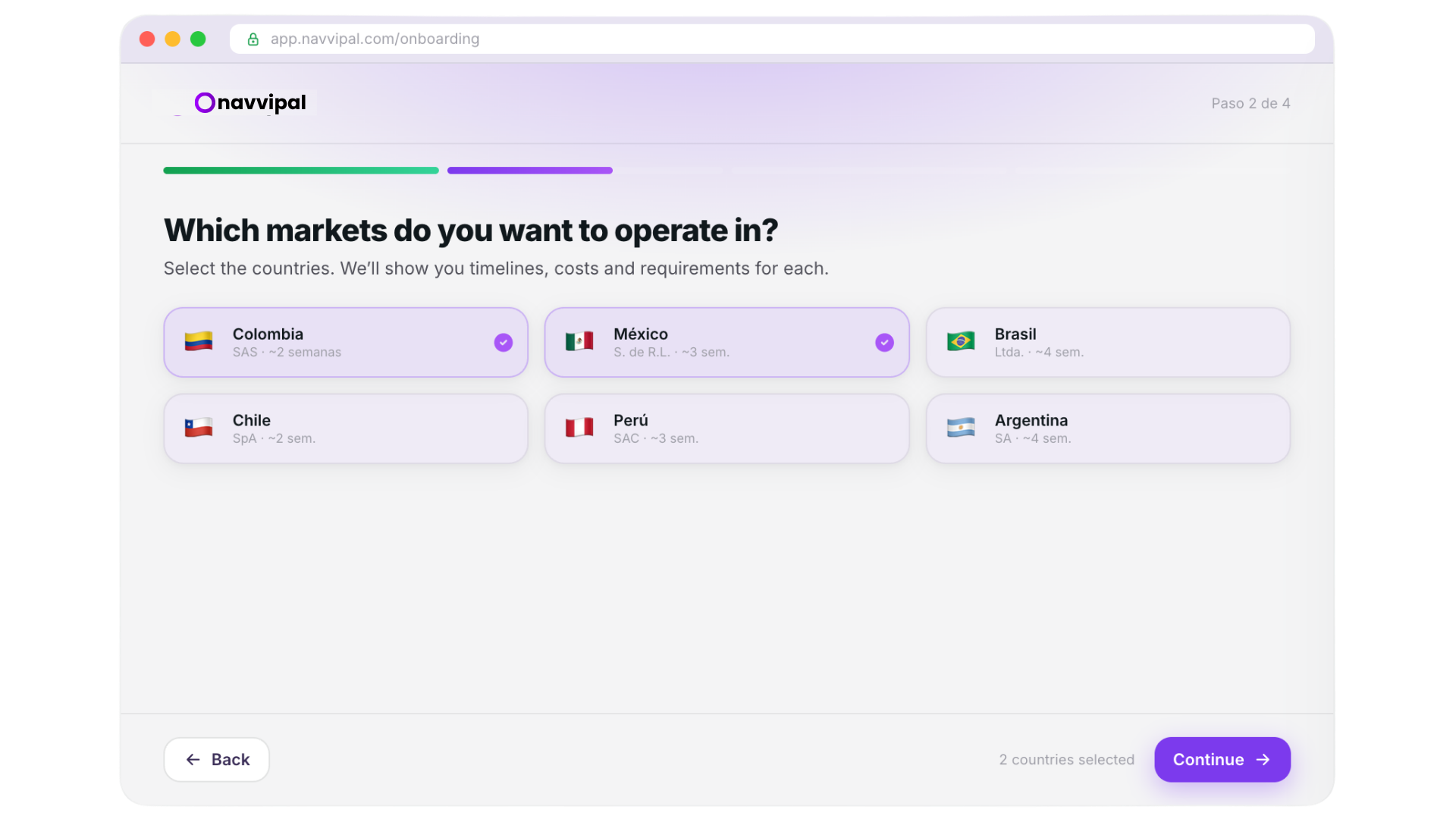
NavviPal's platform tracks your Mexican entity's RFC status, CFDI obligations, monthly filing calendar, and compliance deadlines—so nothing slips through the cracks.
Key Authorities
SAT (Servicio de Administración Tributaria)
Federal tax authority overseeing RFC registration, tax compliance, and electronic invoicing (CFDI)
Local Director Requirement
Mexico does not require a local director or legal representative for most corporate structures. Foreign shareholders and directors can manage the entity remotely, though having a local registered address is mandatory.
Frequently Asked Questions
How long does company formation take in Mexico?
Company formation in Mexico typically takes 8-12 weeks. The process involves notarization by a Mexican Notario Público, registration with the Public Registry of Commerce (Registro Público de Comercio), and RFC registration with SAT (Servicio de Administración Tributaria). Corporate bank account opening is often the slowest step and can extend the timeline further. NavviPal manages the full process end-to-end.
Do I need a local director or legal representative in Mexico?
Mexico does not require a local director or legal representative for most corporate structures. Foreign shareholders and directors can manage the entity remotely. A local registered address is mandatory, and having a local fiscal representative simplifies ongoing SAT interactions.
S.A. de C.V. or S. de R.L.: which entity type should I choose in Mexico?
Both are limited-liability vehicles open to 100% foreign ownership, and the choice usually comes down to structure rather than liability protection. The S.A. de C.V. (Sociedad Anónima de Capital Variable) is a variable-capital stock corporation requiring at least two shareholders, with capital divided into shares that can change without amending the bylaws; it is the structure most foreign-owned subsidiaries use, particularly where future equity financing or share transfers are likely. The S. de R.L. (Sociedad de Responsabilidad Limitada) has ownership organized through partes sociales (quotas) rather than shares, and is more commonly used by smaller or single-purpose foreign subsidiaries with a simpler ownership structure. Both require the same core formation steps: notarization, Public Registry filing, and RFC registration.
What does it cost to form a company in Mexico?
Company formation in Mexico typically ranges from $2,000 to $6,000 USD for the core one-time process, notarization, public registry filing, RFC/RNIE filing assistance, and apostille. Registered address ($540–$1,632/year) and monthly accounting ($300–$2,000/month) are separate recurring costs. See the full cost breakdown for a detailed, component-by-component estimate.
What is PTU (profit-sharing) in Mexico?
PTU (Participación de los Trabajadores en las Utilidades) is a mandatory annual profit-sharing obligation under the Ley Federal del Trabajo. Ten percent of a company's taxable profit must be distributed among employees, split according to days worked and salary earned during the year, with payment due by May 30. Profit-sharing is exempt up to 15 UMAs per employee. PTU applies regardless of whether the company issues dividends, so it is a real annual budgeting item, not an optional bonus, for any foreign employer with a profitable Mexican subsidiary.
What are the ongoing compliance obligations in Mexico?
Mexican entities must file monthly IVA (VAT) and ISR (income tax) declarations, issue all invoices via CFDI (Mexico's mandatory electronic invoicing system), submit annual ISR returns by March 31, maintain monthly accounting records, and file payroll taxes and IMSS/INFONAVIT contributions if employing staff.
What documents are needed to incorporate in Mexico?
Core requirements include: articles of incorporation notarized before a Mexican Notario Público, apostilled copies of foreign shareholder identification documents, proof of a registered address in Mexico, and RFC application documents for SAT. If hiring employees, IMSS registration documents are also required.
Related Resources
Country Comparisons
Formation Guides
Ready to expand into Mexico?
NavviPal handles company formation, compliance, accounting, and tax obligations so you can focus on building your business.