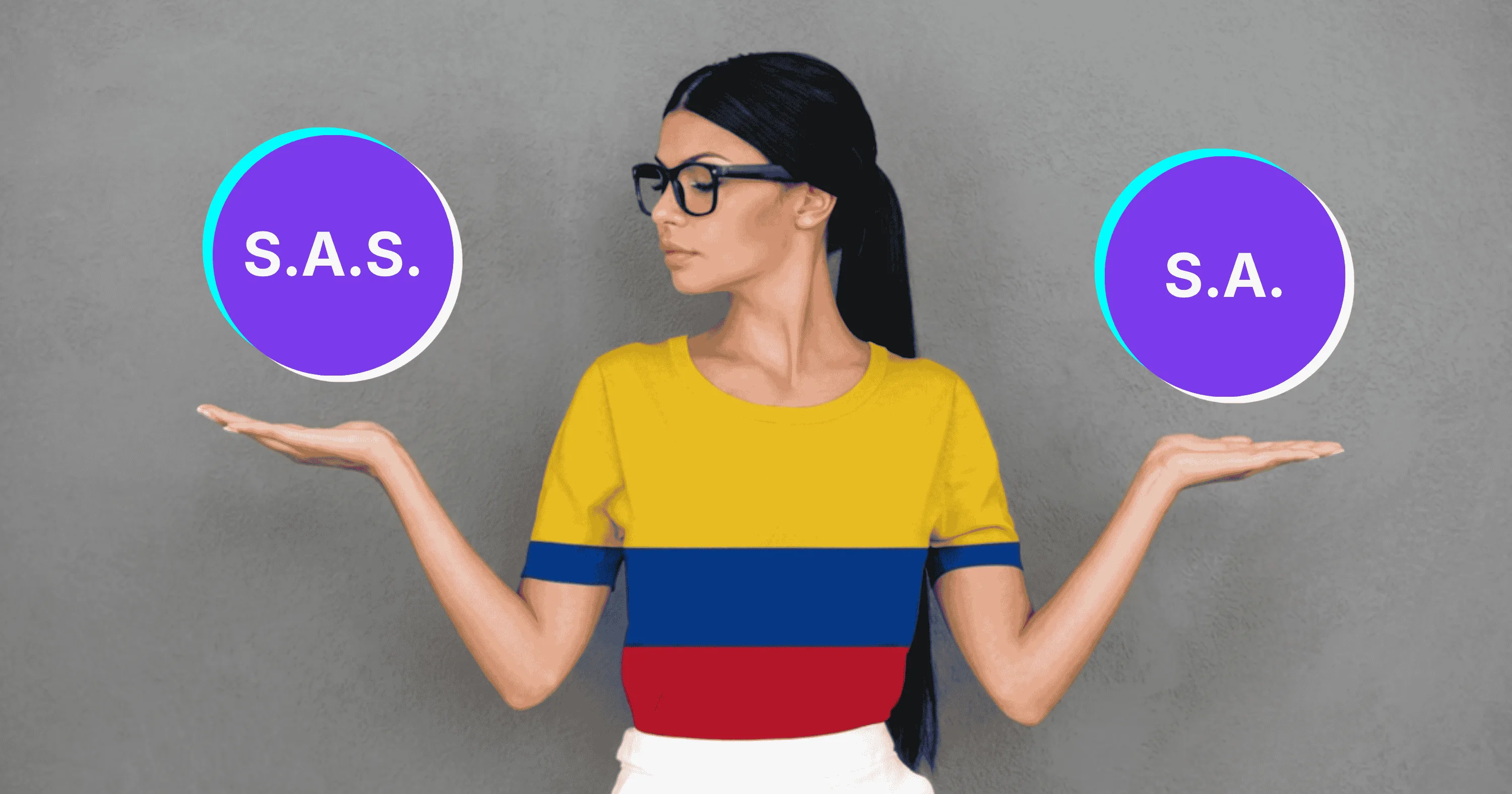
For almost every foreign company setting up in Colombia, the right entity is the S.A.S., not the S.A. As of 2026 the Sociedad por Acciones Simplificada (simplified shares company) can be owned by a single shareholder, formed by a private document, and run with minimal formality, while the older Sociedad Anónima (S.A.) requires at least five shareholders, a board, and a statutory auditor. The S.A. still has its place, but it is the exception. This guide explains the differences that matter and when the exception applies. For the full setup process, see our Colombia company formation guide.
The short answer
Choose the S.A.S. unless a specific legal or commercial reason forces the S.A. The S.A.S. was introduced to be flexible and foreigner-friendly, and it has become the default vehicle for foreign-owned subsidiaries in Colombia.
The S.A.S. in brief
The S.A.S. is a limited liability company whose owners hold shares and whose liability is capped at their capital contribution. Its defining features are practical: it can have a single shareholder (individual or corporate), it is normally incorporated by a private document rather than a notarized deed, its bylaws are highly flexible, and it does not require a board of directors. A statutory auditor (revisor fiscal) is only mandatory once the company crosses certain asset or revenue thresholds, so most early-stage subsidiaries do not need one at formation.
The S.A. in brief
The S.A. is a traditional corporation built for scale and outside investment. It requires a minimum of five shareholders, none of whom may hold 95% or more of the capital, and it must have a board of directors (junta directiva) and a statutory auditor from the outset. That structure suits regulated activities, capital-markets participation, or businesses that specifically need a formal governance framework, but it is heavier than most foreign subsidiaries require.
Head to head
| S.A.S. | S.A. | |
|---|---|---|
| Minimum shareholders | 1 | 5 |
| Formation | Private document (usually no notary) | Public deed |
| Board of directors | Optional | Required |
| Statutory auditor (revisor fiscal) | Only above thresholds | Required from the start |
| Bylaw flexibility | High | Lower, more prescribed |
| Best suited to | Foreign subsidiaries, most SMEs | Regulated sectors, capital markets, large multi-owner entities |
When the S.A. actually makes sense
The S.A. is the right call in a narrow set of cases: when the business operates in a sector that requires it, when it plans to raise capital publicly, or when a shareholder or lender specifically requires the board-and-auditor governance the S.A. provides. Outside those situations, the added shareholders, mandatory auditor, and public-deed formation are cost and friction without benefit.
Converting later
You are not locked in. A Colombian company can be converted from one type to the other, so a foreign investor who starts as an S.A.S. and later needs the S.A. structure (for an investment round or a regulatory requirement) can convert rather than dissolve and re-form. This is another reason most foreign companies start with the simpler S.A.S.
Frequently asked questions
Can a single foreign shareholder own an S.A.S.? Yes. The S.A.S. can have a single shareholder, individual or corporate, foreign or domestic, which is a key reason foreign parent companies favor it.
Does an S.A.S. need a revisor fiscal? Only once it exceeds the asset or revenue thresholds set by law. Many newly formed foreign subsidiaries fall below them at first and appoint one later as they grow.
Why does the S.A. require five shareholders? It is a feature of the traditional corporate form under Colombian company law. For a wholly owned foreign subsidiary, meeting that requirement usually means adding nominal shareholders, which the S.A.S. avoids entirely.
Can I convert an S.A.S. into an S.A. later? Yes. Conversion is possible, so starting with the S.A.S. does not foreclose moving to an S.A. if your circumstances change.
Which do most foreign investors choose? The S.A.S., in the large majority of cases. The S.A. is reserved for specific regulatory, governance, or capital-markets needs.
Compare Colombia with other markets in our comparison tool, or read the Colombia country page for the wider operating picture.
NavviPal forms both entity types across Colombia and 12 other Latin American markets, and can confirm which structure fits your ownership and plans before you commit. Talk to our team to choose the right structure.
Figures last verified: July 2026.
NavviPal · Expand Across Latin America with Confidence.
This article is for informational purposes only and does not constitute legal or tax advice.
Ready to expand into Latin America?
NavviPal manages the full compliance lifecycle for your LATAM entities. Let's talk about your expansion.
Get in Touch