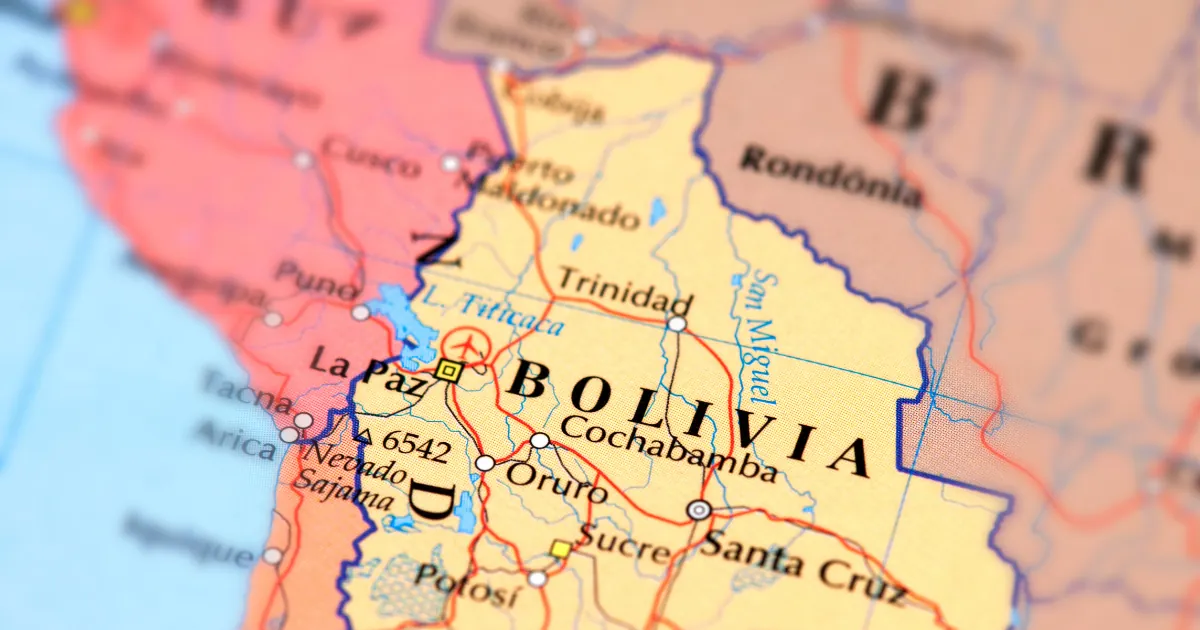
Company Formation in Bolivia
Andean resource-rich market · 8–14 weeks · NIT · Local director required
Formation Process
Bolivia's company formation process involves notarization, registration with SEPREC (Servicio Plurinacional de Registro de Comercio, which replaced Fundempresa in 2022), and NIT registration with the SIN (Servicio de Impuestos Nacionales). A Representante Legal who is Bolivian or holds legal residency is required. Bolivia has one of the longer timelines in Latin America, reflecting its multi-step registration process.
See the full company formation guideFormation Steps
- 1
Notarization of articles of incorporation (escritura de constitución) before a Bolivian notary
- 2
Registration with SEPREC (Servicio Plurinacional de Registro de Comercio, Bolivia's national commerce registry, which replaced Fundempresa in 2022)
- 3
NIT (tax ID) registration with the SIN (Servicio de Impuestos Nacionales)
- 4
Municipal registration and business license (Licencia de Funcionamiento) from the operating municipality
- 5
Appointment of a qualifying Representante Legal with Bolivian nationality or legal residency
Foreign Ownership
Bolivia permits 100% foreign ownership in most commercial and industrial sectors. A Bolivian national or legal resident must serve as Representante Legal, but all economic ownership can be held by foreign nationals. Bolivia's constitution designates certain strategic sectors — natural gas, petroleum, mining, and utilities — as requiring state participation or mixed-ownership structures. NavviPal recommends a sector-specific legal assessment before proceeding.
Local Director: Required
Legal Entity Types
SRL (Sociedad de Responsabilidad Limitada)
Limited liability company, the most common structure for foreign businesses entering Bolivia due to its flexibility and straightforward governance
SA (Sociedad Anónima)
Stock corporation, suitable for larger operations or companies requiring more complex capital structures
Sociedad Colectiva
General partnership recognized under Bolivia's Commercial Code, in which all partners share unlimited joint liability for company debts; typically used by smaller domestic or professional partnerships rather than foreign-owned subsidiaries
Accounting & Tax
All entities operating in Bolivia must register with the SIN and obtain a NIT before commencing business. Bolivia's tax system is relatively straightforward in structure, but requires consistent monthly compliance to avoid penalties.
NIT
The NIT (Número de Identificación Tributaria) is Bolivia's national tax identification number, issued by SIN (Servicio de Impuestos Nacionales). It is required for all tax filings, business transactions, and regulatory compliance in Bolivia.
VAT / IVA
Bolivia's IVA (VAT) is levied at an effective rate of 13% on most goods and services (the nominal rate is 14.94%, but 13% applies after the IT — transaction tax — credit mechanism). Monthly IVA declarations are filed electronically via the NEWTON platform of the SIN.
Corporate Tax
Bolivia's corporate income tax (IUE — Impuesto sobre las Utilidades de las Empresas) is levied at 25% on net taxable income. An additional remittance tax of 12.5% applies when profits are distributed to foreign shareholders. Monthly advance payments are not required — IUE is paid annually.
Compliance Requirements
Annual Obligations
Annual IUE (corporate income tax) return filed with SIN — deadline 120 days after fiscal year end
Annual SEPREC Matrícula de Comercio renewal and updated financial statements
Annual municipal business license (Licencia de Funcionamiento) renewal
Monthly Obligations
Monthly IVA declaration filed electronically via the SIN NEWTON platform
Monthly IT (transaction tax — Impuesto a las Transacciones) at 3% on gross income
Monthly RC-IVA (complementary income regime) withholding if applicable
Monthly CNS (Caja Nacional de Salud) and Gestora Pública (pension) contributions if employing staff
Payroll & Employment
Bolivia's labor framework is governed by the Ley General del Trabajo. Bolivia has strong worker protections and significant mandatory benefits that substantially increase the effective employment cost, including a distinctive rule where severance (indemnización) is owed after 90 days of continuous employment regardless of whether the employee resigns or is terminated.
Mandatory benefits include a 13th month salary (Aguinaldo, Christmas bonus), a 14th month salary ("Doble Aguinaldo," a second bonus applied when GDP growth exceeds 4.5%), and 15 days paid vacation per year
Social security contributions: employer approximately 16.71% of gross salary (CNS health + Gestora Pública pension + housing fund + pro-employment fund); employee approximately 12.71%
All employment must be registered with the Gestora Pública (the state pension administrator that replaced the former private AFP system in 2023) and CNS from day one; employer liability for unregistered employees is significant
NavviPal coordinates payroll processing and Ley General del Trabajo compliance through vetted Bolivian in-country partners. Contact our team before your first hire.
Talk To An ExpertWhy Bolivia
Bolivia offers access to South American markets and competitive cost structures, backed by the world's largest known lithium reserves and significant natural gas and mineral exports. Foreign ownership is permitted in most commercial sectors, though a Bolivian legal representative is required, and the regulatory environment, from multi-step company registration to a currency regime that shifted to a managed float in June 2026, calls for careful, locally supported navigation rather than a self-serve approach.
12M
Population
~$45B USD
GDP (2024 est.)
World's largest Li reserves
Key Resource
Boliviano (BOB)
Currency
Managing Your Entity with NavviPal
NavviPal's platform tracks your Bolivian entity's NIT status, SIN filing calendar, SEPREC renewal dates, and IUE annual tax deadline.
Key Authorities
SIN (Servicio de Impuestos Nacionales)
National tax authority responsible for NIT issuance, tax administration, and compliance oversight
Registro de Comercio (SEPREC)
Commercial registry responsible for company registration and corporate record maintenance
Local Director Requirement
Bolivia requires companies to have a legal representative (Representante Legal) who is a Bolivian national or holds legal residency in Bolivia. Bolivian law and a 2015 Supreme Court ruling require the representative to give reasonable notice and continue acting until a replacement is formally registered with SEPREC, since an abrupt resignation can create personal liability for resulting damages. NavviPal provides a qualified local legal representative who acts solely on your company's instructions, with indemnity protections in place.
Frequently Asked Questions
How long does company formation take in Bolivia?
Company formation in Bolivia typically takes 8-14 weeks end to end, one of the longer timelines in Latin America due to the multi-step registration process. Formation itself, notarization and registration with SEPREC (Bolivia's national commerce registry), usually takes 5 to 6 weeks; NIT tax registration with the SIN and opening a corporate bank account add several more weeks. NavviPal manages the process to minimize delays.
Do I need a local director or legal representative in Bolivia?
Yes. Bolivia requires companies to appoint a legal representative (Representante Legal) who is a Bolivian national or holds legal residency in Bolivia. The Representante Legal has signing authority and is responsible for regulatory compliance with SEPREC and the SIN tax authority.
What types of companies can I form in Bolivia?
Bolivia recognizes several company types, though foreign investors typically choose between two. The SRL (Sociedad de Responsabilidad Limitada) is the most common structure for foreign-owned subsidiaries: a limited liability company with flexible, straightforward governance. The SA (Sociedad Anónima) suits larger operations or more complex capital structures, with ownership organized through shares rather than quotas. Bolivia's Commercial Code also recognizes the Sociedad Colectiva, a general partnership in which all partners carry unlimited joint liability for company debts, typically used by smaller domestic or professional partnerships rather than foreign-owned subsidiaries, so it's rarely the right fit for an inbound investor. All structures require a local Representante Legal, and 100% foreign ownership is permitted in most commercial sectors outside natural resources and utilities.
What does it cost to form a company in Bolivia?
Company formation in Bolivia typically ranges from $850 to $1,200 USD for the core process, reflecting the longer timeline and multi-step registration requirements. Ongoing costs include monthly VAT filings, accounting, and the local Representante Legal. NavviPal provides transparent, itemized quotes, contact us for your specific scenario.
What is the NIT and why is it needed?
The NIT (Número de Identificación Tributaria) is Bolivia's national tax identification number, issued by the SIN. It is required for all tax filings, commercial invoicing, banking, contracts, and business operations in Bolivia. The NIT is also needed to register employees with the Caja Nacional de Salud (social security).
Does an employee in Bolivia keep severance if they resign voluntarily?
Yes, and this is a distinctive feature of Bolivian labor law that surprises many foreign employers. Unlike most of the region, Bolivia's Ley General del Trabajo, as interpreted by the Constitutional Court, requires severance (indemnización) to be paid even on voluntary resignation, once the employee has completed at least 90 days of continuous service. This applies on top of the standard 13th-month Aguinaldo and any accrued vacation, and it changes how employers should budget for turnover: an employee's exit, even a resignation with no dispute, carries a real cash liability that doesn't exist in most neighboring countries.
What documents are needed to incorporate in Bolivia?
Core requirements include: notarized articles of incorporation (escritura de constitución), registration with SEPREC, NIT registration with SIN, apostilled and officially translated copies of foreign shareholder identification documents, proof of a registered address in Bolivia, and appointment of a qualifying Representante Legal with Bolivian residency or nationality.
Related Resources
Country Comparisons
Formation Guides
Ready to expand into Bolivia?
NavviPal handles company formation, compliance, accounting, and tax obligations so you can focus on building your business.