
Company Formation in Argentina
South America's 3rd largest economy · 8-16 weeks · CUIT · Majority-resident board required
Formation Process
Company formation in Argentina involves registration with the IGJ (Inspección General de Justicia) in Buenos Aires or the equivalent provincial registry, and CUIT registration with AFIP. A foreign company acting as shareholder must first register itself under Article 123 of the General Companies Law before the local subsidiary can be incorporated, the step that most often drives the overall timeline. An absolute majority of the board (or all gerentes for an S.R.L.) must also be Argentina residents. The S.A.S. (Sociedad por Acciones Simplificada) is the most streamlined modern structure for individually-owned entities and can be registered digitally. Argentina's regulatory environment is complex, and NavviPal manages the full process.
See the full company formation guideFormation Steps
- 1
Drafting articles of incorporation (estatuto social): a private document for the S.A.S., notarized for the S.A. or S.R.L.
- 2
Registration with the IGJ (Buenos Aires) or provincial Registro Público de Comercio; a foreign corporate shareholder must first register itself under Article 123 of the General Companies Law before the local entity can be incorporated
- 3
CUIT registration with AFIP (Administración Federal de Ingresos Públicos)
- 4
IVA and Ingresos Brutos (provincial gross income tax) registration
- 5
Opening a corporate bank account in Argentina
Foreign Ownership
Foreign nationals can own 100% of the equity in an Argentine entity, with no nationality requirement for shareholders. Board composition is a separate question from ownership: under Article 256 of the General Companies Law, an absolute majority of an S.A.'s directors (or all of an S.R.L.'s gerentes) must be Argentina residents, regardless of nationality, unless the entity is structured as an S.A.S., which needs only one resident manager. Currency controls have eased since 2025: dividends from profits earned in fiscal years starting on or after January 1, 2025 can now move through the official FX market, though profits accumulated before that date and repayment of pre-existing intercompany debt principal remain restricted. NavviPal recommends a current review of FX access conditions and board-residency structuring before investing in Argentina.
Local Director: Not Required
Legal Entity Types
SRL (Sociedad de Responsabilidad Limitada)
Limited liability company, commonly used by small to mid-sized foreign businesses
SA (Sociedad Anónima)
Stock corporation, used for larger operations and companies requiring more complex capital structures
SAS (Sociedad por Acciones Simplificada)
Simplified stock corporation, available in certain jurisdictions and growing in popularity for its flexibility
Accounting & Tax
All entities operating in Argentina must register with AFIP and obtain a CUIT before commencing operations. Argentina has a multi-layered tax system — federal (AFIP), provincial (Ingresos Brutos), and municipal — with frequent regulatory changes.
CUIT
The CUIT (Clave Única de Identificación Tributaria) is Argentina's unique tax identification code, issued by AFIP (Administración Federal de Ingresos Públicos). It is required for all tax filings, employment, and business transactions.
VAT / IVA
Argentina's IVA (VAT) is levied at a general rate of 21%, with a reduced rate of 10.5% for certain goods (food, medicine, utilities). Monthly or bi-monthly IVA declarations are filed electronically through the AFIP portal. Inflation-adjusted invoicing and accounting is mandatory.
Corporate Tax
Corporate income tax (Impuesto a las Ganancias) is levied progressively at 25% up to ARS 50 million, 30% from ARS 50 to 100 million, and 35% above that threshold, plus a 7% dividend withholding. Monthly advance payments are required. Argentina remains classified as IAS 29 hyperinflationary for IFRS purposes, so financial statements must still be restated for inflation every period, a standing requirement that continues even in years when the inflation rate itself falls, not a one-time adjustment.
Compliance Requirements
Annual Obligations
Annual corporate income tax return (Ganancias) filed with AFIP — deadline varies by CUIT digit
Annual Ingresos Brutos (provincial gross income tax) reconciliation with the relevant provincial agency
Annual IGJ/registry filings including financial statements and officer appointments
Monthly Obligations
Monthly IVA declaration filed electronically with AFIP (or bi-monthly for smaller entities)
Monthly Ingresos Brutos provincial tax filing
Monthly SIPA (pension) and obra social (health) contributions via AFIP if employing staff
Monthly inflation-adjusted accounting records and balance sheet updates
Payroll & Employment
Argentina's labor framework is governed by the Ley de Contrato de Trabajo (LCT) and collective bargaining agreements (convenios colectivos). Employer obligations are extensive and employment relationships are strongly protected by law.
Mandatory benefits include 13th-month salary (SAC — sueldo anual complementario), 14 days minimum paid vacation (increasing with seniority), and significant termination indemnity (1 month per year of service)
Employer social security contributions (cargas sociales) total approximately 24–27% of gross salary; employee contributions approximately 17%
All payroll, social security, and termination payments must comply with the applicable collective bargaining agreement (CCT) for the industry sector
NavviPal coordinates payroll processing and LCT compliance through vetted Argentine in-country partners. Argentina's labor law is one of the most employee-protective in the region — contact our team before your first hire.
Talk To An ExpertWhy Argentina
Argentina's economy centers on technology and software services, agribusiness, and financial services, supported by a highly educated, Spanish-speaking workforce that has made the country a significant nearshoring and export-services hub despite recurring macroeconomic volatility. Board composition carries a structural requirement most foreign investors don't expect: an absolute majority of an S.A.'s directors, or all of an S.R.L.'s gerentes, must be Argentina residents under Article 256 of the General Companies Law. Investors weighing Argentina against other LATAM markets should budget for this resident-director requirement and for IAS 29 hyperinflation accounting as ongoing structural costs, not one-time setup items.
46M
Population
~$640B USD
GDP (2024 est.)
Tech talent base
Key Advantage
ARS (Peso)
Currency
Managing Your Entity with NavviPal
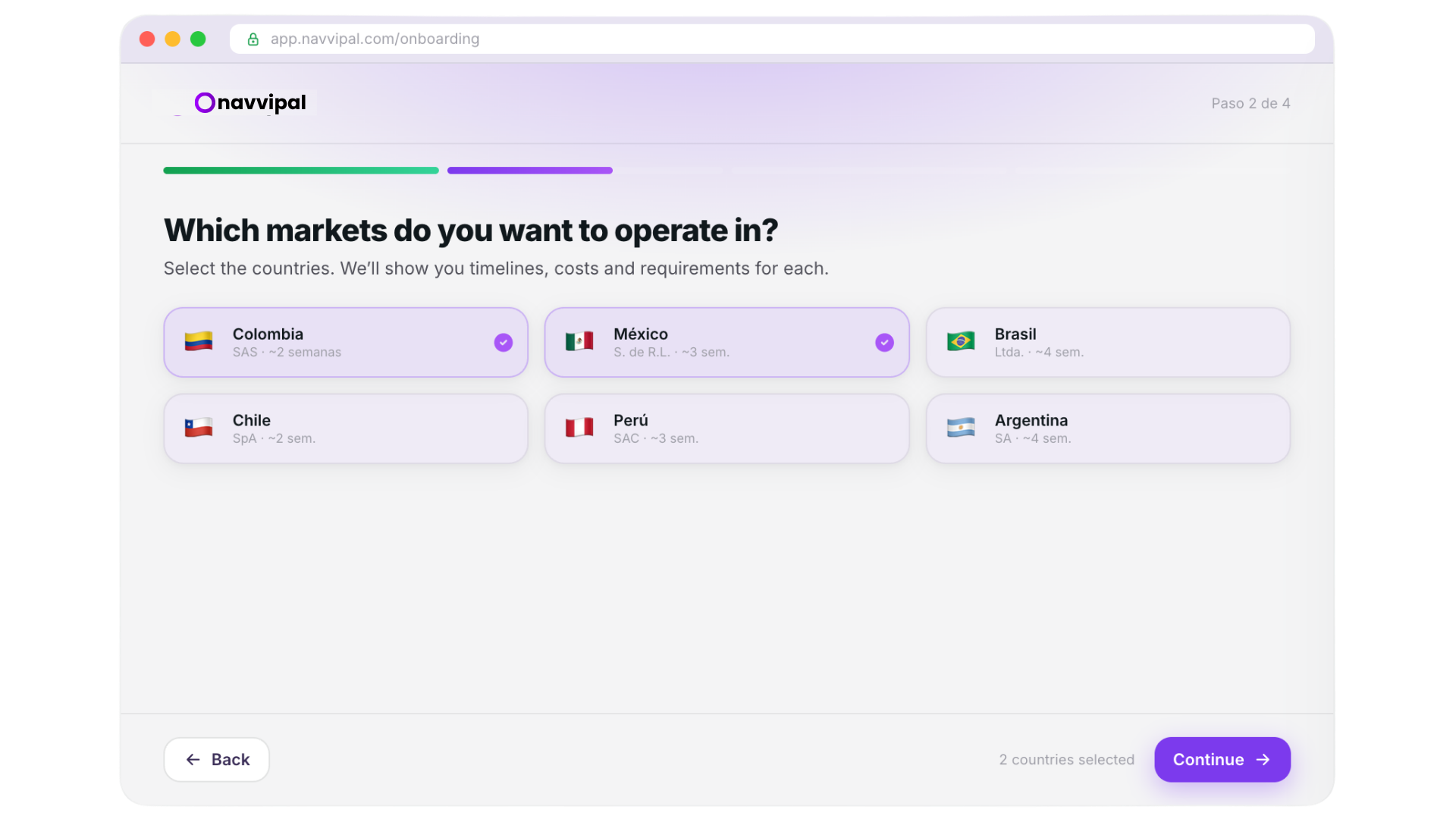
NavviPal's platform tracks your Argentine entity's CUIT status, AFIP filing calendar, IVA obligations, and Ingresos Brutos deadlines — critical given Argentina's high compliance frequency.
Key Authorities
AFIP (Administración Federal de Ingresos Públicos)
Federal tax authority responsible for CUIT registration, tax compliance, and revenue collection
IGJ (Inspección General de Justicia)
Corporate registry authority in Buenos Aires overseeing company registration and corporate compliance
Local Director Requirement
Under Article 256 of Argentina's General Companies Law, an absolute majority of an S.A.'s board of directors (or all of an S.R.L.'s gerentes) must have their domicilio real, their actual legal residence, in Argentina. A Sociedad por Acciones Simplificada (S.A.S.) has a lighter version of this rule and needs only one Argentina-resident member of its management body. Foreign nationals can hold board seats and full economic control, but the residency majority itself cannot be waived. This is commonly satisfied by appointing a professional or nominee resident director alongside the foreign management team.
Frequently Asked Questions
How long does company formation take in Argentina?
Company formation in Argentina typically takes 8 to 16 weeks for a foreign corporate shareholder, since the shareholder must first complete a separate Article 123 registration before the local entity can be incorporated; local or individual-only shareholders can complete the process faster. Buenos Aires City entities register with the IGJ (Inspección General de Justicia); other provinces use their own registries. The process involves notarization, registry approval, and CUIT registration with AFIP.
Do I need a local director or legal representative in Argentina?
Yes, in effect. Under Article 256 of Argentina's General Companies Law, an absolute majority of an S.A.'s board of directors (or all of an S.R.L.'s gerentes) must have their legal residence in Argentina, regardless of nationality. The S.A.S. (Sociedad por Acciones Simplificada) has a lighter version of this rule and needs only one Argentina-resident manager. Foreign investors typically satisfy this by appointing a professional or nominee resident director. Separately, an S.A. or traditional S.R.L. needs at least two shareholders, while the S.A.S. allows single-person ownership.
Can foreigners own 100% of a company in Argentina?
Yes, foreign nationals can own 100% of an Argentine entity with no nationality requirements for shareholders. However, currency controls (CEPO cambiario), profit repatriation restrictions, and inflation-adjusted accounting requirements make it essential to understand the operating framework before investing. NavviPal advises a thorough pre-investment assessment for Argentina.
What does it cost to form a company in Argentina?
Company formation in Argentina typically ranges from $800 to $2,000 USD for the core process. Ongoing costs are notable due to inflation-adjusted accounting requirements and the complexity of Argentina's tax framework. NavviPal provides transparent, itemized quotes, contact us for your specific scenario and a realistic picture of total annual costs.
What is the CUIT and why is it needed?
The CUIT (Clave Única de Identificación Tributaria) is Argentina's unique tax identification number, issued by AFIP (Administración Federal de Ingresos Públicos). It is required for all tax filings, banking, contracts, import/export, and business activities in Argentina. Each director and shareholder also requires their own CUIT or CUIL.
What are the ongoing compliance obligations in Argentina?
Argentine entities must file monthly tax reports (VAT, income tax, payroll taxes) with AFIP, prepare inflation-adjusted financial statements (ajuste por inflación), submit annual corporate filings with the IGJ or provincial registry, hold mandatory shareholder meetings, and maintain detailed accounting records. Argentina's compliance framework is one of the most demanding in the region.
What documents are needed to incorporate in Argentina?
Core requirements include: notarized articles of incorporation (estatuto social), registration with the IGJ (Buenos Aires) or provincial registry, Article 123 registration of any foreign corporate shareholder before the local entity can be incorporated, CUIT registration with AFIP, apostilled and legalized copies of foreign shareholder identification documents, proof of a registered address in Argentina, and initial capital deposit documentation. S.A.S. registration is simpler and can be completed digitally for individually-owned structures.
Related Resources
Country Comparisons
Formation Guides
Ready to expand into Argentina?
NavviPal handles company formation, compliance, accounting, and tax obligations so you can focus on building your business.