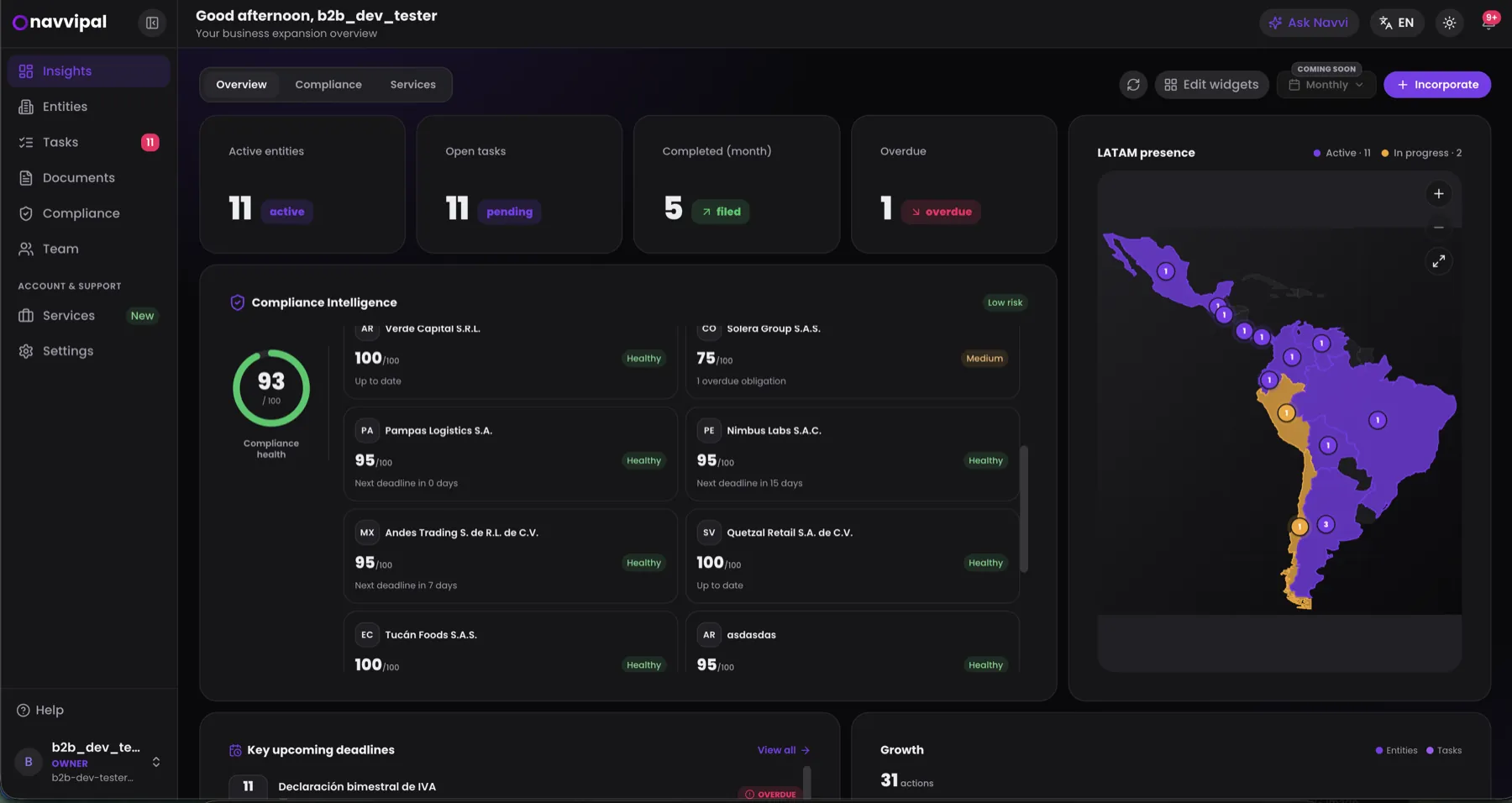
Launch, manage, and scale your entities across LATAM through one platform and one trusted partner for company formation, compliance, accounting, tax, and corporate governance.
We learn about your business, growth plans, hiring strategy, and target markets.
Country recommendation
Entity recommendation
Timeline
Scope of services
02
Company Formation
Step 02
Company Formation
NavviPal manages:
Incorporation documents
Government registration
Tax ID registration
Corporate records
Banking introductions
Timeline: Typically a Few Weeks
03
Compliance Setup
Step 03
Compliance Setup
We establish:
Registered Address
Local Director
Company Secretary
Annual Entity Filings
04
Accounting & Tax
Step 04
Accounting & Tax
Monthly support includes:
Bookkeeping
VAT / IVA filings
Payroll tax filings
Financial reporting
Annual accounts
05
NavviPal Platform
Step 05
NavviPal Platform
Our platform gives you complete visibility and control across all your LATAM entities — the key differentiator compared to traditional law firms and local providers.
Our Legal Compliance Package is built around the four obligations every foreign entity in LATAM must maintain annually.
01
Registered Address
Every entity must maintain a legally recognised address in its country of registration for official correspondence.
Official government mail handling
Regulatory notice receipt
Full digital forwarding via NavviPal platform
Annual renewal included
02
Local Director
Many LATAM jurisdictions require at least one resident director on the company record at all times.
Qualified in-country director
Satisfies residency requirements
Acts on company instructions only
Indemnity protections in place
03
Co-Sec & Annual Filings
Your company secretary manages all statutory obligations and ensures filings are never missed.
Annual return preparation & filing
Statutory registers maintained
Board resolutions & minutes
Deadline tracking via NavviPal
04
Accounting & Tax
Local accounting support keeps your books, tax filings, and financial reporting accurate and on schedule.
Monthly bookkeeping
Tax declarations prepared
Financial reports maintained
Local accountant coordination
Common questions
Frequently asked questions
How do I register a company in Latin America?
Registering a company in Latin America starts with choosing the country and legal entity that match your commercial goals, ownership structure, hiring plan, and tax position. The incorporation process then usually includes preparing shareholder documents, securing apostilles and certified translations where required, appointing a legal representative or resident agent, establishing a registered address, filing with the commercial registry, and obtaining a local tax ID. Requirements are country-specific: Colombia commonly uses an S.A.S., Brazil a Limitada, Mexico an S. de R.L. de C.V., and Chile a SpA. Registration is only the first stage. A new entity may also need foreign-investment reporting, municipal registrations, a corporate bank account, accounting setup, tax filings, payroll registrations, and a compliance calendar. NavviPal coordinates company formation and the post-incorporation steps across its supported LATAM markets, with local specialists and one platform for tracking documents, deadlines, and entity status.
How do I register a company in Colombia as a foreigner?
A foreign investor will usually register a company in Colombia as a Sociedad por Acciones Simplificada (S.A.S.), a flexible entity that can have one shareholder and permits 100% foreign ownership in most sectors. The incorporation process includes selecting a company name, drafting the bylaws and private incorporation document, registering with the Chamber of Commerce, obtaining the RUT and NIT tax registrations with DIAN, appointing a legal representative, and opening the corporate bank account. Foreign shareholder documents and powers of attorney generally need to be apostilled and translated into Spanish. Capital brought into Colombia should also be registered with Banco de la República so future dividends and capital can be remitted correctly. Formation commonly takes around two to four weeks in the repository’s Colombia guidance, although banking can extend the operational timeline. NavviPal can coordinate Colombia company formation, legal representation, tax registration, foreign-investment reporting, banking support, and ongoing corporate compliance.
How do I open a company in Brazil?
Most foreign businesses open a company in Brazil as a Sociedade Limitada (Ltda.), although a Sociedade Anônima may suit larger or capital-raising structures. Brazil company formation involves preparing the Contrato Social, appointing a Brazil-resident attorney-in-fact for each nonresident quotaholder, registering through the state Board of Trade and Redesim, selecting the tax regime, and obtaining a CNPJ from Receita Federal. Foreign corporate records and powers of attorney normally require an apostille and certified Portuguese translation. The company also needs a Brazilian registered address, municipal registrations and operating licences where applicable, and registration of foreign capital through the Central Bank’s RDE-IED system to support future repatriation. The repository describes Brazil as one of LATAM’s more complex markets, with banking KYC and ownership-chain documentation often affecting timing. NavviPal supports the full Brazil incorporation process, including local representation, CNPJ and foreign-investment registration, operational setup, accounting, tax compliance, and payroll coordination.
How much does it cost to register a company in Mexico?
The cost of company registration in Mexico is not one fixed fee. It depends on the legal entity, state, notary, number and location of shareholders, apostille and translation requirements, powers of attorney, registered address, and the support needed after incorporation. The repository’s Mexico cost guidance separates third-party formation expenses from NavviPal’s professional fees and also distinguishes one-time incorporation costs from recurring accounting, tax, payroll, legal-representation, and compliance costs. A typical foreign-owned company must budget for drafting and notarising the deed, registration with the Public Registry of Commerce, RFC tax registration with SAT, foreign-investment registration where applicable, and corporate bank account onboarding. The S. de R.L. de C.V. and S.A. de C.V. also have different governance implications that can affect scope. Because quotes vary materially by structure, NavviPal provides an itemised company formation proposal for the specific Mexican entity, shareholders, state, and ongoing services rather than presenting an unreliable universal price.
What is the fastest country to register a company in Latin America?
There is no universally fastest country to register a company in Latin America because the right comparison depends on entity type, shareholder documents, tax registration, banking, and whether “formed” means registry approval or fully operational. NavviPal’s repository comparison identifies Panama at approximately two to three weeks and Colombia at two to four weeks among the quicker standard estimates, while Ecuador and Costa Rica are also relatively streamlined. Brazil, Mexico, and Argentina generally require longer lead times because of additional formalities and operational complexity. A fast registry filing can still be followed by bank KYC, foreign-investment registration, municipal licensing, or tax activation. Speed should therefore be weighed alongside foreign ownership, local representative requirements, compliance burden, market access, hiring needs, and capital movement. NavviPal compares the formation timeline and ongoing obligations market by market, then coordinates incorporation, tax registration, banking support, and compliance so the chosen LATAM entity is not merely registered quickly but ready to operate correctly.
Can a foreigner own 100% of a company in Latin America?
Foreigners can own 100% of a company in most LATAM jurisdictions and sectors covered by NavviPal, but foreign ownership and local management are separate questions. Colombia’s S.A.S., Brazil’s Ltda., Mexico’s S. de R.L. de C.V., Chile’s SpA, and several other common entities generally allow full foreign economic ownership. However, a country may still require a resident legal representative, administrator, director, or licensed resident agent. Brazil, for example, requires resident representation for nonresident shareholders, while Colombia requires a legal representative and Panama requires a lawyer or law firm as resident agent. Certain regulated or strategic industries—including areas such as media, aviation, healthcare, utilities, natural resources, or border land—may have additional restrictions depending on the country. Foreign capital may also need central-bank or investment-registry reporting to preserve repatriation rights. NavviPal confirms the ownership rules for the target market and entity, arranges compliant local representation, and coordinates foreign-investment and ongoing corporate filings.
What documents are required to register a company?
Company registration requirements vary by country and entity type, but a foreign shareholder will usually provide identification, proof of address, ownership and beneficial-owner information, and signed powers of attorney. If the shareholder is another company, registries and banks commonly request its certificate of incorporation, constitutional documents, good-standing evidence, board approval for the investment, and documents tracing the ultimate beneficial ownership chain. Overseas documents may need an apostille or legalisation plus a certified Spanish or Portuguese translation. The local formation package normally includes proposed company names, bylaws or articles, details of directors and the legal representative, the registered address, business activities, and stated share capital. Tax authorities and banks can request additional KYC, source-of-funds, or operational evidence. Because Brazil, Mexico, Colombia, and other LATAM markets apply different formalities, a universal checklist can be misleading. NavviPal prepares a jurisdiction-specific document list, checks formalities before filing, and coordinates registration, tax IDs, local appointments, and banking support.
How long does company formation take in Latin America?
Company formation in Latin America can take from a few weeks to several months, depending on the country, legal entity, shareholder structure, document readiness, and what is included in the timeline. NavviPal’s repository comparison gives standard estimates ranging from roughly two to three weeks in Panama and two to four weeks in Colombia to six to ten weeks in markets such as Brazil and Argentina; individual country guides may use longer end-to-end estimates when tax activation and operational steps are included. Apostilles, certified translations, resident representative appointments, registry review, and foreign-investment filings can all affect incorporation time. Corporate bank account opening is a separate KYC process and is often the largest variable, particularly for complex foreign ownership chains. A realistic project plan should distinguish legal registration from being ready to invoice, hire, and transact. NavviPal sequences company incorporation, tax registration, registered address, local representation, banking support, accounting, and payroll setup, while tracking dependencies and deadlines through one platform.
What is the best legal entity for foreign companies?
The best legal entity for a foreign company depends on the country, number of shareholders, liability protection, governance preferences, tax treatment, funding plans, and intended operations. There is no single LATAM-wide equivalent of an LLC. Common choices include Colombia’s S.A.S., Brazil’s Sociedade Limitada, Mexico’s S. de R.L. de C.V., Chile’s SpA, Peru’s S.A.C., and Argentina’s S.R.L. Simplified structures often offer flexible governance and limited liability, while an S.A. may be more appropriate for a larger ownership base, formal board governance, or future capital raising. A branch can appear simpler but may require special authorisation and can expose the foreign parent more directly. Entity selection should also account for local representatives, minimum shareholder rules, capital, tax registrations, transfer pricing, profit repatriation, and annual filings. NavviPal compares the structures available in the chosen jurisdiction and coordinates local legal and tax input so the entity supports both immediate company formation and long-term compliance.
What is the difference between an LLC and an S.A.?
An LLC-style entity and a Sociedad Anónima (S.A.) both generally provide limited liability, but they differ in ownership form, governance, and administrative burden. LATAM limited-liability structures—such as Brazil’s Ltda., Mexico’s S. de R.L., or an S.R.L. elsewhere—usually divide capital into quotas or membership interests and often allow more contractual flexibility and a simpler management structure. An S.A. divides capital into shares and typically follows more formal corporate governance, including shareholder meetings, directors or a board, statutory books, and additional reporting rules. That can make an S.A. suitable for larger businesses, multiple investors, or planned capital raising, while an LLC-style company often fits a closely held foreign subsidiary. The exact distinction is jurisdiction-specific: an S.A. in Panama is not governed identically to one in Mexico or Colombia. Tax treatment and local filing obligations also require separate review. NavviPal helps foreign investors compare entity types in the target country and implement the chosen structure with the required registrations and governance.
Do I need a legal representative?
Most companies operating in Latin America need an authorised local point of contact, but the role may be called a legal representative, resident director, administrator, attorney-in-fact, or resident agent. The requirement and powers vary by jurisdiction and entity type. Colombia requires its companies, including an S.A.S., to appoint a legal representative. Brazil requires resident representation in connection with the company and nonresident shareholders. Mexico needs a representative able to deal with SAT and hold the relevant tax registration, while Panama and Costa Rica use lawyer-resident-agent models in certain situations. This appointment does not normally transfer economic ownership, but the authority granted must be carefully defined because a legal representative may sign, receive official notices, or bind the company. The appointee also has to remain valid after incorporation. NavviPal identifies the exact local representation requirement, provides qualified professionals where available, structures appointments to act on the company’s instructions, and monitors renewals and governance records as part of ongoing entity compliance.
Can NavviPal provide a registered address?
Yes. NavviPal provides registered-address support across its available LATAM markets, subject to the rules and availability in each jurisdiction. A registered address is the legally recognised location recorded with the commercial registry and tax authority for official government, regulatory, and legal correspondence. It is not always the same as an operating office, and some countries impose physical-presence or address-specific conditions. The repository emphasises that a compliant address must do more than appear on incorporation documents: notices should be received, scanned, logged, forwarded, and acted on before deadlines expire. Unmonitored mail can lead to missed tax notices, administrative penalties, loss of good standing, or default legal action. NavviPal’s service can include a compliant local address, receipt of official correspondence, digital forwarding and notifications through the platform, and annual maintenance. The team also advises whether the intended business, bank, or tax registration requires a separate functional office rather than only a statutory registered address.
How do I open a corporate bank account?
Opening a corporate bank account in Latin America normally begins after the entity has been registered and obtained its tax identification number. The bank will conduct its own KYC and anti-money-laundering review, asking for incorporation documents, bylaws, tax registration, registered address, authorised signatories, beneficial-owner records, ownership-chain documents, business plans, expected transaction flows, and evidence of source of funds. Foreign corporate documents may need apostilles and certified translations, and some banks expect a local legal representative or in-person step. Requirements and timelines differ substantially by bank and country, so bank account opening should not be treated as an automatic part of registry approval. The repository identifies banking—especially verification of a foreign ownership chain—as a frequent operational bottleneck. NavviPal introduces clients to banks that work with foreign-owned entities, prepares and coordinates the onboarding file, and aligns banking with company formation and operational setup. The bank remains responsible for approval and may request additional evidence.
What happens after company incorporation?
After company incorporation, the new legal entity still needs to become operational and remain compliant. Typical post-incorporation work includes activating the tax ID, completing municipal or sector registrations, reporting foreign investment, opening the corporate bank account, funding the company, setting up bookkeeping and invoicing, and establishing a tax filing calendar. The company must maintain its registered address, legal representative, statutory books, beneficial-ownership records, shareholder or board approvals, and annual corporate filings. Before hiring, it may also need labour, social-security, and payroll registrations, compliant employment contracts, and a local payroll process. Obligations can start from the incorporation date even if the business has no revenue, so leaving a new entity dormant does not necessarily eliminate returns or annual renewals. NavviPal coordinates these post-incorporation compliance and operational steps through local lawyers, accountants, tax advisers, and payroll specialists, while its platform centralises corporate documents, filing deadlines, correspondence, financial reporting, and entity status.
What ongoing compliance obligations does my company have?
Ongoing entity compliance in Latin America combines corporate governance, tax, accounting, regulatory, and—when employees are hired—payroll obligations. The exact calendar is country-specific, but companies commonly need monthly bookkeeping and tax declarations, VAT or indirect-tax filings, payroll and social-security reporting, annual corporate income tax returns, statutory financial statements, shareholder meetings, commercial-registry renewals, beneficial-ownership reports, and updates when directors, shareholders, addresses, or activities change. The company must also maintain statutory books, invoices, corporate records, a registered address, and a valid legal representative or resident agent. Some filings apply even when the entity is dormant. Foreign-owned companies may have additional investment, transfer-pricing, or central-bank reporting. Missing a deadline can trigger penalties or loss of good standing, and obligations differ materially between Brazil, Mexico, Colombia, and other jurisdictions. NavviPal maps the applicable compliance calendar, coordinates local filings and corporate secretarial work, and gives clients visibility into deadlines, documents, and status through one platform.
Can NavviPal manage accounting and tax filings?
Yes. NavviPal coordinates accounting and tax compliance for supported LATAM entities through in-country accounting professionals. The service can cover monthly bookkeeping, transaction categorisation, VAT or IVA declarations, corporate and payroll tax filings, financial reporting, annual statutory accounts, and coordination with the relevant tax authority, such as Mexico’s SAT, Brazil’s Receita Federal, or Colombia’s DIAN. Scope and filing frequency depend on the jurisdiction, tax regime, activity, and size of the company; there is no single regional tax calendar. Cross-border groups may also need transfer-pricing documentation, withholding analysis, and alignment between the local entity’s tax position and the parent company’s wider structure. NavviPal’s platform helps finance teams track filing deadlines, review monthly or quarterly reports, store supporting documents, and see the status of accounting and tax work across multiple countries. Local tax advice is intended to complement, not replace, the company’s home-country adviser when decisions affect both jurisdictions.
How do I hire employees after incorporation?
Once the LATAM entity is formed, it can hire employees directly, but it must first be registered with the relevant labour, payroll, tax, and social-security authorities. The employer should use locally compliant employment contracts, classify workers correctly, establish payroll before the first start date, and budget for statutory benefits and employer contributions in addition to base salary. Requirements vary by country and can include paid leave, bonuses or thirteenth-month salary, severance funds, profit sharing, health or pension contributions, and digital payroll reporting. Hiring through your own entity differs from using an employer of record: the company becomes the legal employer and carries the employment, payroll, termination, and compliance obligations itself. A regional policy cannot simply replace local rules in Brazil, Mexico, Colombia, or another jurisdiction. NavviPal’s HR advisory supports contract requirements, payroll registration and processing coordination, mandatory benefits, employment-law monitoring, and termination guidance so the entity can hire and pay its local team compliantly.
How do I close a company in Latin America?
Closing a company in Latin America requires a formal dissolution and liquidation process; stopping trade or leaving the entity inactive does not end its legal, tax, or filing obligations. Although the steps vary by country, shareholders generally approve dissolution, appoint a liquidator, register the company as being in liquidation, prepare an inventory and closing balance sheet, notify creditors, collect assets, settle employees, taxes, and other liabilities in the required priority, approve the final liquidation account, and distribute any remaining assets. Final tax returns must be filed and tax, commercial, payroll, municipal, and foreign-investment registrations cancelled where applicable. An insolvent company may need a separate court or statutory insolvency procedure rather than voluntary liquidation. Records and statutory books may also need to be retained after closure. NavviPal manages liquidation and dissolution scope through local professionals, coordinating corporate approvals, creditor and tax work, registrations, and final cancellation so the company is legally closed rather than merely abandoned.
How long does company liquidation take?
Company liquidation in Latin America usually takes several months, but there is no reliable region-wide timeline. Duration depends on the jurisdiction, entity type, whether the closure is voluntary, the company’s accounting records, outstanding tax returns, employees, assets, creditors, contracts, litigation, and the speed of shareholder and authority approvals. A clean, solvent dormant company can generally move faster than an operating business with liabilities or unresolved compliance. The repository’s Colombia guidance describes an orderly voluntary liquidation as a multi-month process involving dissolution, registration, a liquidator, an inventory and balance sheet, creditor settlement, final accounts, tax closure, and cancellation before the Chamber of Commerce. If debts cannot be paid, insolvency rules may replace the voluntary process and take longer. Continuing filings may remain due until the tax ID and registry record are formally cancelled. NavviPal reviews the entity’s compliance position first, defines a country-specific liquidation plan, and coordinates corporate, accounting, tax, and registration work through final closure.
Why use NavviPal instead of multiple local providers?
Using separate law firms, accountants, company secretaries, payroll providers, and spreadsheets in every LATAM country creates fragmented ownership of deadlines, documents, and entity status. NavviPal combines in-country specialists with one regional operating model and one platform. Clients can coordinate company formation, registered address, legal representation, corporate governance, annual filings, accounting, tax, payroll, operational setup, and liquidation without rebuilding the provider network for each market. Local professionals still handle jurisdiction-specific work, but documents, correspondence, compliance calendars, financial reporting, and project status are visible in a central workspace. This matters because Latin American requirements are highly local: a process that works for a Colombian S.A.S. cannot simply be copied to a Brazilian Ltda. or Mexican S. de R.L. NavviPal’s role is to preserve that local expertise while giving legal and finance teams a consistent point of coordination, clearer accountability, and regional visibility as their entity portfolio grows.